Every millisecond counts when a self-driving car needs to brake for an unexpected obstacle or avoid a sudden collision. Today’s connected vehicles generate massive streams of sensitive trip and location data, but sending all that information up to remote cloud servers can cause dangerous lag times—and leaves drivers open to surveillance and digital snooping.
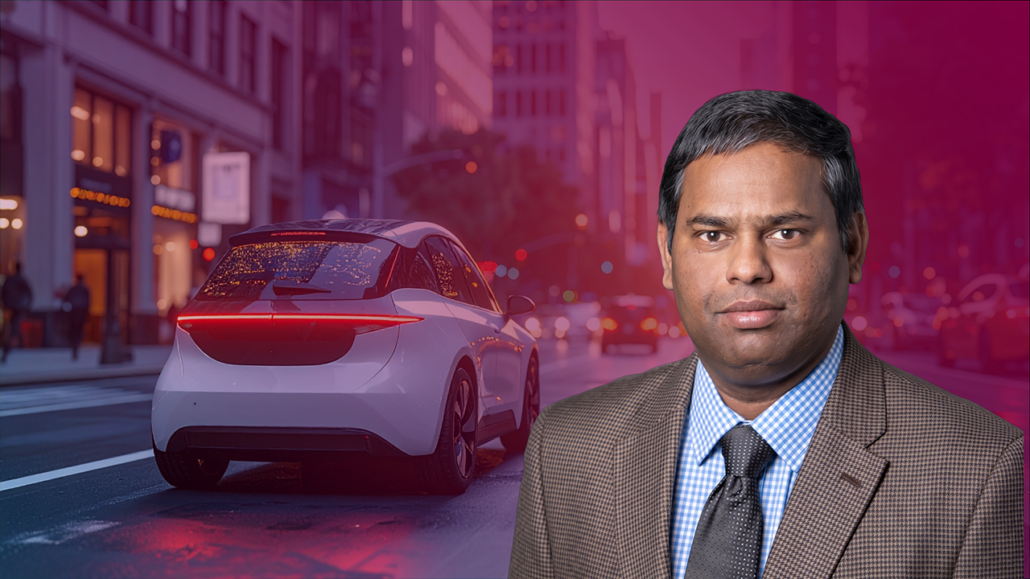
A new study co-authored by Meharry School of Applied Computational Sciences (SACS) faculty member Uttam Ghosh, Ph.D., professor of cybersecurity, reveals a new framework that allows autonomous fleets to share crucial safety intelligence in real time without exposing personal passenger data.
Dr. Ghosh’s co-authors for the study are Eugene Levin, Ph.D., professor of spatial data science; Pushpita Chatterjee, Ph.D., assistant professor of computer science and data science; Debashis Das, Ph.D., postdoctoral fellow; and La Chiara Landrum, a data science Ph.D. student. The study is part of the project CAMPUS (Community Air Mobility for Public Utilization in Support of Healthcare) funded by a $742,286 grant.
“Our study is important applications to privacy preserving for smart cars,” said Dr. Ghosh. “But our integrations of federated learning, privacy-preserving AI and edge-cloud computing can also be applied to challenges using other smart devices such as UAVs in protecting health care data, emergency response and community safety.”
Published in the 2026 International Conference on Intelligent Multimedia, Networking, and Security (IMNS), the team’s research reimagines how smart vehicles “think” on the road. Rather than shipping private location details and camera feeds across the internet, the cars train artificial intelligence systems locally right inside their own onboard computers.
Smarter Vehicles in Three Tiers
The architecture solves the twin dilemmas of slow network lag and data vulnerabilities by splitting intelligence into a tiered system:
- Local Machine Learning: Each vehicle uses its own onboard sensors to recognize patterns and hazards, adjusting its internal AI model without broadcasting raw trip records.
- Neighborhood Edge Checkpoints: The cars send mathematical updates — never raw footage or GPS tracks — to nearby roadside servers, known as Multi-access Edge Computing (MEC) units. These local stations process insights instantly to handle fast-moving traffic conditions.
- Tamper-Proof Verification: Roadside nodes run a decentralized verification ledger that screens out malicious nodes and ensures rogue data cannot corrupt the driving network.
- Mathematical Privacy Shields: The system applies differential privacy—a cryptographic technique that injects calculated digital “noise” into the data. This mathematically guarantees that outside observers cannot reverse-engineer a driver’s exact movements or habits, while still allowing the broader system to learn safely.
- Global Cloud Synchronization: Only vetted, aggregated insights reach the central cloud layer, drastically cutting transmission costs and bandwidth strain across municipal networks.
By eliminating central data honeypots, this framework proves that next-generation transportation infrastructure can protect both physical road safety and digital human rights.
Landrum’s participation is a great example of the workforce opportunities NASA makes possible through funding the CAMPUS project.
“Working on NASA CAMPUS has been a valuable opportunity to apply what I have learned as a Ph.D. student to real-world research,” said Landrum. “The experience has allowed me to explore the intersection of AI, cybersecurity, federated learning, and UAV systems while contributing to peer-reviewed research.”
This privacy-preserving smart car study is just one of the many projects combining cybersecurity and AI at Meharry SACs. Learn how you can start using data science, AI and cybersecurity to solve real-world community challenges.
Explore our cybersecurity assurance program.
Learn more about our graduate programs
View more research publications.