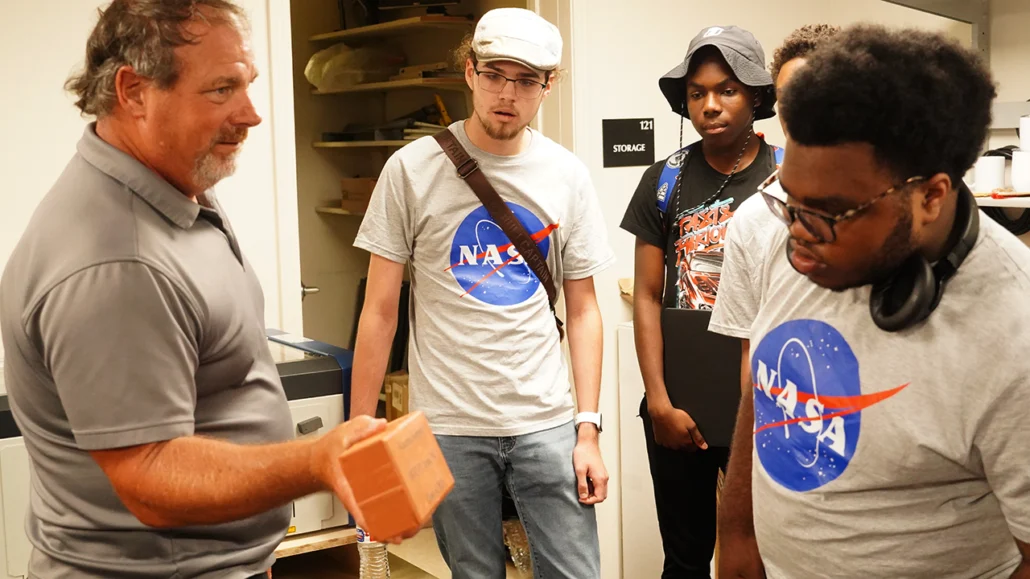
NASHVILLE, Tennessee — Looking to inspire the next generation of aerospace and technology leaders, the Meharry Medical College School of Applied Computational Sciences, known as SACS, hosted its Collaborative Interactive Data Science Academy this summer, running July 13-24. The free, two-week residential program introduced 25 high school students to NASA applications of data science, robotics and artificial intelligence.

The academy was made possible by a five-year, $418,448 grant from NASA’s Minority University Research and Education Project, known as MUREP, designed specifically to address longstanding gaps in access and opportunity within high-tech STEM fields. Hosted in partnership with Austin Peay State University in Clarksville, Tennessee, the camp brought together talented students — nominated by their high school teachers — who often lack access to advanced robotics and data science coursework in their regular curricula.


Fortune S. Mhlanga, dean of Meharry SACS, said ahead of the program that the academy was meant to open doors students might not otherwise see.
“This is an exciting opportunity to expose high school students to some of the latest applications of data science and robotics,” Mhlanga said. “We want to open their eyes to a future full of possibilities through science and show them they can create their own path in this world.”
Beyond the Textbook: VR, Robots and Real Data
Rather than traditional classroom lectures, the academy immersed students in a hands-on environment built around NASA’s geospatial and extraterrestrial big data. Using virtual, augmented and mixed reality headsets, students stepped into simulated lunar and Martian environments, manipulated virtual robots and analyzed real spatial data streams directly inspired by active NASA missions like Artemis and Mars exploration.

They also programmed physical robots to navigate obstacle courses mimicking rugged extraterrestrial terrain, explored remote sensing and solar system modeling, met virtually with an active NASA astronaut, and sat in on a career pathways session covering emerging high-tech fields including quantum mechanics.

Massive in scope
Principal investigator Eugene Levin, professor of spatial data science at Meharry SACS, said making missions of that scale land for a teenager was the whole design challenge behind the program.
“NASA data and missions are massive in scope — how do you make something like Artemis or Mars exploration feel tangible to a 16-year-old?” he said. “We put students inside the mission. When a teenager slips on a HoloLens headset and suddenly finds themselves docking a module on the International Space Station, or pilots a simulated Apollo 8 return through VR — that is no longer abstract. They are not reading about NASA, they are doing NASA.”


Every hands-on activity tied back to an active mission, Levin added: the camp’s Mars coding challenges mirrored real rover programming logic, and its remote sensing exercises used the same Earth observation data NASA scientists analyze daily.
Chaperone David Lockett watched that shift happen up close.
“One of the most powerful moments was watching students put on the VR headsets and realize they were not simply playing a game — they were using NASA data to navigate virtual environments and control robotic systems,” he said. “You could see their confidence grow when they solved a challenge, programmed a robot successfully, or made the connection between data, coding, robotics and real NASA missions.”
That connection didn’t stay confined to the lesson plan, Lockett said.
“During downtime students talk about technology, the VR experiences and the challenges they were trying to solve as teams,” he said. “They compare what they learned, ask one another questions about coding and technology, and begin connecting the experience to careers they had not previously considered — such as data science, robotics, engineering, GIS, cybersecurity and space science. Those informal conversations show that the learning continues beyond the classroom and starts to become part of how they imagine their own future.”


Addressing the Pipeline Challenge
By targeting students before they enter college and providing an elite level of technology, access and mentorship, Meharry SACS aimed to fundamentally change the trajectory of underrepresented youth in tech.
Levin said the program’s design — and its home at SACS — was central to that mission.
“The multicultural environment at SACS, enhanced by collaboration with neighboring HBCU Fisk University, creates a unique learning ecosystem where diversity is the norm rather than the exception,” he said. “This setting allows students to engage with advanced technologies like computer vision, machine learning and cybersecurity without the psychological burden of being ‘the only one’ in the room — a common experience that drives many underrepresented students away from STEM fields.”
“Within SACS’s multicultural framework, students can focus on mastering complex concepts like 3D model production from smartphone and quadcopter imagery without simultaneously navigating social isolation or imposter syndrome,” he said.
Levin tied that environment directly back to Meharry’s founding purpose.
“Meharry’s mission has always been about removing barriers — to health, to opportunity, to the future,” he said. “The vast majority of the students who walk through our program are African American, and many come from communities that have been historically underrepresented in STEM. NASA partnership gives us the tools, the credibility and the content to show those students that the highest levels of science and exploration are not just open to them — they are enriched by them.”
“Data science, AI, remote sensing, cybersecurity: these are not only aerospace skills, they are the foundations of precision medicine, environmental health monitoring and the next generation of health equity research,” he said. “When we train a young person from an underserved community to think like a NASA data scientist, we are not just building the astronaut pipeline — we are building the researchers and innovators who will one day help close the health disparities that Meharry has fought against for more than 150 years.”
At 16, Levin said, students are still deciding who they’re allowed to become — and that’s exactly where immersive tools do their work.
“Immersive technology collapses the distance between ‘I could never do that’ and ‘I just did that,'” he said. “When our students program an interactive robot, analyze satellite imagery of their own communities through Google Earth Engine, or present an AI-generated film they produced themselves — they leave with evidence that they belong in these fields.”
“That evidence is extraordinarily hard to give through a textbook and nearly impossible to take away once a student has experienced it firsthand,” he said. “We see it in our surveys, we hear it in their testimonials, and we watch it in the room: these young people walk in curious and walk out confident.”
Lockett saw the same shift from the parent’s-eye view.
“I would tell parents that their child is gaining far more than exposure to technology,” he said. “They are building confidence, problem-solving skills, teamwork, communication, critical thinking and an understanding of how space science and data can be used to solve real-world problems. Students work with robotics, spatial data, computer vision and immersive technology while also learning that STEM is accessible and that they belong in these spaces.”
That belief in what’s possible, Lockett added, is often the real payoff.
“NASA camps at SACS expand what students believe is possible,” he said. “For many students, careers in data science, artificial intelligence, robotics, aerospace or NASA-related research can feel nonexistent until they have a chance to interact with the tools, data and people behind that work. Once they begin programming a robot, exploring Mars in VR, or speaking with an astronaut, those careers become more visible and achievable. The experience helps students move from saying, ‘That is interesting,’ to saying, ‘I can see myself doing that.'”
Chaperone David Lockett watched that shift happen up close.
“One of the most powerful moments was watching students put on the VR headsets and realize they were not simply playing a game — they were using NASA data to navigate virtual environments and control robotic systems,” he said. “You could see their confidence grow when they solved a challenge, programmed a robot successfully, or made the connection between data, coding, robotics and real NASA missions.”
That connection didn’t stay confined to the lesson plan, Lockett said.
“During downtime students talk about technology, the VR experiences and the challenges they were trying to solve as teams,” he said. “They compare what they learned, ask one another questions about coding and technology, and begin connecting the experience to careers they had not previously considered — such as data science, robotics, engineering, GIS, cybersecurity and space science. Those informal conversations show that the learning continues beyond the classroom and starts to become part of how they imagine their own future.”


Looking Ahead
As NASA continues its ambitious exploration goals, the seeds sown in Tennessee this summer may well power the future discoveries of tomorrow’s aerospace and data science leaders.
Lockett put it simply:
“Meharry isn’t just a medical college, and Meharry SACS isn’t just a computational sciences school,” he said. “It’s a launchpad for student innovation, discovery and opportunity — where students can see themselves as the next generation of astronauts, data scientists, health innovators, engineers, researchers and explorers.”