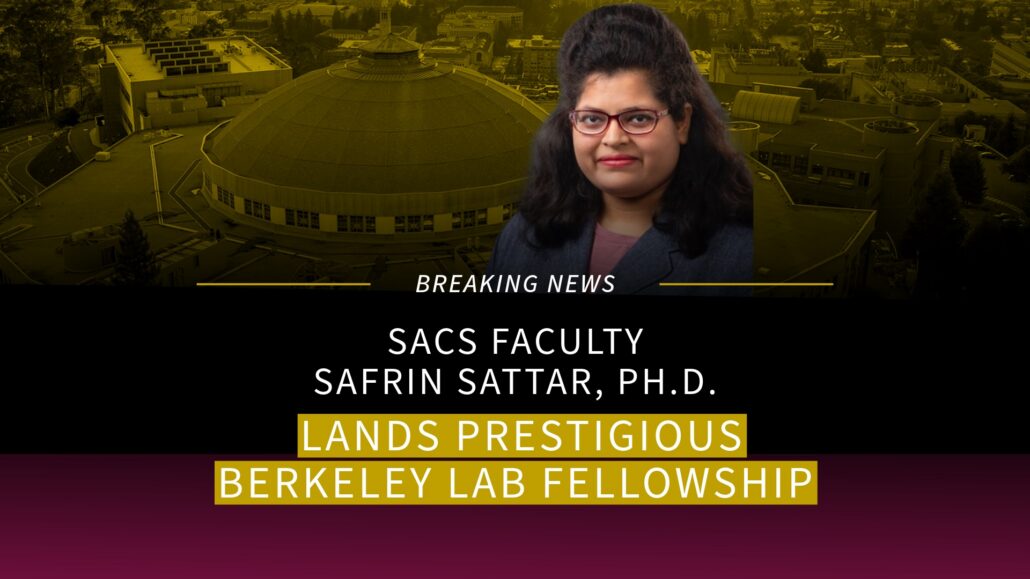
Dr. Naw Safrin Sattar’s selection for the Visiting Faculty Program reflects what happens when an HBCU-based computational sciences school insists on building at the frontier, not observing it from the sidelines
"It reframes SACS and Meharry more broadly as upstream innovators in AI-enabled science." — Dr. Naw Safrin Sattar
Sixteen Nobel laureates have walked the halls of Lawrence Berkeley National Laboratory. This year, a thirteen-person cohort of visiting faculty from across the country’s national labs will join that lineage — and one of them is building her career at Meharry Medical College’s School of Applied Computational Sciences (SACS), a program young enough that its first graduating classes are still early in their careers.
That’s the detail worth sitting with. Not the prestige of the lab, though there’s plenty of that. It’s the gap between where SACS started and where Dr. Sattar is now standing — and what it says about a school that has decided, from its founding, not to wait its turn.
Dr. Sattar’s path to Berkeley Lab began the way many origin stories do: quietly, years before anyone else could see where it was headed, with a PhD summer internship at the lab in 2019. She’s returning now not as a trainee but as a funded principal investigator, bringing two SACS master’s students with her, and carrying a project — “Accelerating Scientific Discovery through Graph-based Agentic Retrieval-Augmented Generation” — that DOE’s Office of Science backed with roughly $40,000 in funding. She was also personally invited by Dr. Ibrahim to apply for the Genesis Mission AI initiative, one of the largest AI research investments in the country.
We sat down with Dr. Sattar to talk about the honor, the students she’s bringing with her, and what she believes this moment means for SACS, for Meharry, and for the next generation of scientists coming out of Nashville.
Lawrence Berkeley National Laboratory has produced 16 Nobel Prize winners. What does it mean to you and to SACS to be selected for a program associated with that kind of scientific legacy?
Being selected for the Visiting Faculty Program at Lawrence Berkeley National Laboratory is both humbling and energizing for me. This is a place where foundational discoveries in physics, chemistry, and energy science have literally reshaped how we understand the world, so bringing my work in AI, large-scale graph analytics, and scientific computing into that ecosystem feels like joining a living scientific legacy rather than just visiting a lab. Lawrence Berkeley National Laboratory holds a special place for me, as I began my national lab experience with a summer internship at Berkeley Lab back in 2019 during my PhD. It’s been a life-changing experience for me, shaping my career and the research I’m doing today.
For Meharry SACS, being a relatively young School of Applied Computational Sciences, competing on the same stage with long-established institutions is impressive. Our proposal has been awarded ~$40,000 funded by the Office of Science of the Department of Energy. This year, only 13 faculty members have been selected to work at Berkeley Lab, and a total of 92 faculty members will participate across all Department of Energy (DOE) National Laboratories. Only 21 students will join the faculty awardees on the collaborative research projects, and 2 of our SACS students are within this competitive pool. This emphasizes that our vision — using AI, high-performance computing, and data science to tackle real scientific and societal problems — is aligned with the national agenda, and that our students and faculty are seen as co-creators in cutting-edge science, not just observers.
You’re bringing two SACS master’s students with you to Berkeley Lab. How does an experience like this working inside a $1.5 billion national research facility change the trajectory of a biomedical data science student’s career?
Very few biomedical data science students ever get to work inside a national lab environment with world-class supercomputing facilities and data platforms. For our SACS master’s students, this experience changes their trajectory because it connects what they learn in the classroom directly to how large-scale science is actually done — on real DOE datasets, real HPC systems, and in collaboration with teams of material scientists, chemists, and computer scientists.
Instead of just reading about knowledge graphs, AI for science, or the Materials Project in a paper, they’ll help build and run workflows on those platforms and see their code contribute to active research. That kind of exposure makes PhD programs, national lab careers, and industry roles in AI-driven drug discovery, precision medicine, or materials design feel attainable — especially for students from communities that have historically been excluded from these spaces.
Dr. Ibrahim has personally invited you to apply for the DOE’s Genesis Mission AI funding, one of the largest AI research investments in the country. What does that kind of peer recognition signal about the work being done here at SACS?
The Genesis Mission AI initiative is one of DOE’s flagship efforts to build transformative AI systems for science, with millions of dollars committed across its phases. To be personally encouraged to apply signals that our work at SACS in scalable graph-based AI, high-performance computing, and trustworthy AI for science is viewed as relevant to that national vision.
It says that a mission-driven, HBCU-based school like SACS is not only training data scientists but also contributing ideas and infrastructure that can shape how AI will be used for energy, materials, health, and environmental research. For our students, this recognition sends a clear message: the problems they care about and the skills they are building in Nashville can have impact at the highest levels of science and technology policy.
Many people think of cutting-edge energy and materials science research as the domain of large R1 universities. How does SACS being represented at Lawrence Berkeley Lab challenge or reframe that assumption?
Our presence at Lawrence Berkeley Lab directly challenges the idea that “big science” only belongs to a small group of elite R1 institutions. When SACS faculty and students are working alongside Berkeley Lab scientists on the same supercomputers and platforms that power projects like ours in the material science domain — utilizing cutting-edge AI and HPC platforms — we are helping to design the algorithms, data structures, and AI workflows that others will rely on in the future.
It reframes SACS and Meharry more broadly as upstream innovators in AI-enabled science.
What responsibility do you feel as a SACS faculty member at one of the nation’s premier research institutions to bring that knowledge and those connections back to your students and community?
I feel a deep responsibility to treat this opportunity not as an individual success, but as an investment in our students, our school, and our community. The Visiting Faculty Program is designed to increase research capacity at institutions like Meharry, and that means my job is to bring back more than publications. I need to bring back new collaborations, new curriculum modules, and new pathways for our students to engage with DOE science.
Practically, that looks like co-developing projects with Berkeley Lab scientists, inviting lab collaborators to our school for seminars, and building pipelines for internships, joint theses, and future proposals.
For our Nashville community and the populations Meharry serves, it also means ensuring that the AI and data science methods we develop for materials or other domains eventually translate into benefits for health equity and local workforce development.
Tell me about the subject of your research at Lawrence Berkeley National Laboratory and what it means for the future of the fields of material sciences and biomedical data science.
Our project is titled “Accelerating Scientific Discovery through Graph-based Agentic Retrieval-Augmented Generation: A Scalable Framework for Material Science and Cross-Domain Knowledge Synthesis,” and it focuses on building a trustworthy, scalable AI assistant for science that is grounded in DOE’s high-quality materials data. We will use curated resources such as the Materials Project and the Open Quantum Materials Database to build a high-fidelity knowledge graph that encodes crystal structures, synthesis pathways, and materials properties as an immutable source of truth.
On top of that graph, we will design an agentic Retrieval-Augmented Generation system — essentially a scientific AI copilot — that can autonomously help with tasks like literature review, hypothesis generation, and experiment planning, but always with its reasoning checked against the structured knowledge graph and executed on HPC resources at NERSC, utilizing Berkeley’s CBorg infrastructure for developing our workflow. In materials science, this could dramatically speed up how we discover and optimize new materials. Moving forward, in biomedical data science and related DOE areas such as bioinformatics and environmental toxicology, the same framework can unify diverse data sources into explainable, queryable graphs that support more robust, equitable scientific insights.
Ultimately, I see this work as part of a broader shift toward AI-native scientific ecosystems, where diverse teams can collaborate through shared knowledge graphs and reliable agentic systems that accelerate scientific discovery while preserving scientific rigor.
Dr. Naw Safrin Sattar is a faculty member at Meharry Medical College’s School of Applied Computational Sciences (SACS). She conducted her research through the DOE Visiting Faculty Program at Lawrence Berkeley National Laboratory, accompanied by two SACS master’s students.