
Maternal and Child Health
MOMS-TN
Meharry Outreach for Maternal Support – Tennessee
Reducing preventable maternal mortality in rural Tennessee through mobile care, community workforce and telehealth.

We meet women during pregnancy, on their terms and in their communities, so that we can keep them alive after delivery.
MOMS-TN is not a new idea waiting for infrastructure. It is waiting to be activated.
Rural Tennessee women deserve better
Across Middle Tennessee’s small towns and rural communities, women face real barriers to maternal care, even when they live close to home.
- No one close by
Four of our six focus counties have no birthing hospital with a full labor and delivery unit. Women travel more than 30 minutes for a prenatal visit. - Care that stops at delivery
The weeks after delivery carry the highest maternal mortality risk — yet postpartum surveillance in rural communities is nearly absent. - Conditions that go unaddressed
Mental health, cardiovascular disease, substance use and hemorrhage (the four leading causes of pregnancy–associated death in Tennessee) often go unscreened and untreated. - A system that asks too much
Transportation barriers, lack of paid leave, and workforce shortages combine to make “just go to the clinic” an answer that doesn’t work for rural mothers.
These are not statistics. They are our neighbors — and they have waited long enough.
A promise, spelled out.
A multi-year program led by the School of Medicine, Center for Women’s Health Research, the School of Graduate Studies at Meharry Medical College, and Homeland Health Birth and Wellness Collective, to bring real, lasting maternal health care to rural Tennessee – care that arrives before crisis, stays through recovery, and builds a community workforce that outlasts the grant.
Every component is a commitment made to keep.
Care that comes to you
Present
A mobile clinic visits your county on a regular schedule — prenatal appointments that don’t require a half-day drive.
Continuous
After delivery, the mobile unit comes back. Doulas and community health workers check in at home. No one falls through in the weeks that matter most.
Integrated
Specialists join your visit by video when needed. Lab tests collected at home, processed at Meharry — no separate trip.
Trusted
Doulas and CHWs trained by Homeland Heart Birth and Wellness Collective — community members serving their own neighbors.
Thorough
Mental health, heart health, substance use, and hemorrhage risk all screened and addressed in one visit — not scattered across multiple referrals.
How It Works
Four tiers. One seamless continuum.
1. Mobile clinical team
Midwives and PAs under OBGYN supervision deliver scheduled prenatal visits across a rotating six-county circuit — then return as postpartum care vehicles after delivery.
→ Prenatal → Postpartum
2. Telehealth + EDA platform
A Digital Health Platform, developed and managed by Meharry’s Enterprise Data Analytics Division, brings OB/GYN, MFM, cardiology and behavioral health specialists to the mobile unit visit by video when clinically needed.
→ Need-based, not routine
3. Meharry self-collect lab
Patients collect their own specimens at home using validated kits. Meharry’s Consolidated Lab processes everything – billed to insurance. No extra trip required.
→ Home → Lab → Results
4. Community workforce
Homeland Heart-trained doulas and CHWs (PSI PMADs and QPR certified) conduct postpartum home visits, monitor blood pressure, identify warning signs, and walk alongside women for 12 months.
→ 12 months of follow-up
Targeting what's taking Tennessee mothers' lives
The Tennessee Maternal Mortality Review Committee identifies these as the top drivers of pregnancy-associated death. MOMS-TN addresses all four in every visit.
Mental health and substance use
EPDS screening at every visit. On-demand telehealth therapists for same-visit connection — closing the gap between a positive screen and actual care. CHWs sustain follow-up through 12 months.
Target: ≥ 90% screened · ≥ 70% same-visit connection
Cardiovascular disease
Blood pressure tracked throughout pregnancy. Self-collect lipid and troponin panels for risk stratification. Remote BP monitoring kits deployed through doulas and CHWs for home surveillance.
Target: ≥ 70% BP control at 6-week postpartum
Postpartum hemorrhage
Doulas and CHWs trained in early warning sign recognition and direct clinical escalation — routed to Nashville General Hospital L&D under Dr. Appiah, Chief of Women’s Services.
Target: Clinical response ≤ 4 hours from community alert
Substance use disorder
Oral fluid SUD testing via LC-MS/MS — witnessed by the telehealth provider without compromising privacy. MOUD initiation at the mobile unit. CHW-sustained postpartum recovery support.
Target: ≥ 95% screened · ≥ 60% MOUD initiation
Six Counties Across Middle Tennessee
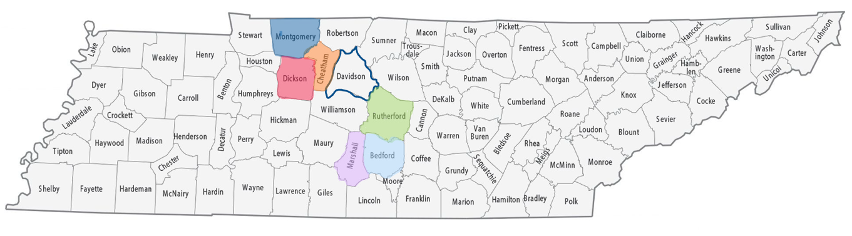
All within approximately one hour of Meharry Medical College. Selected because they are rural by designation and because they have been underserved for too long.
Year 1 — Immediate launch
- Bedford*
- Rutherford
- Montgomery
* Bedford County — Meharry Health Network anchor (existing community relationship)
Years 2 and 3 — Full six-county deployment
- Cheatham
- Dickson
- Marshall
Matthew Walker Comprehensive Health Centers serve as safety-net access points in Rutherford (Smyrna) and Montgomery (Clarksville) Counties.
What these counties share:
- All are rural by federal designation.
- All are within about 60 minutes of Meharry.
- Four have no birthing hospital with full L&D.
- Each has only one community health center.
- Primary care shortages range from needing 12 to 19 additional providers per county.
- Rutherford and Montgomery face rapid population growth outpacing health care infrastructure.
Local Hands. Trusted Partners
Leadership Team
Leslie Appiah, MD
Contact PI · OB/GYN
Chair OB/GYN, Nashville General Hospital
Director, Meharry Medical College Center for Women’s Health Research
Taneisha Gillyard-Cheairs, Ph.D.
PI · Full-spectrum community doula
BRIDGE Framework senior author
Perinatal Health Equity Researcher
Freida Outlaw, RN, Ph.D.
Co-I · Former CHW program lead (mental health focus)
Ashutosh Singhal, Ph.D.
Co-I · Chief Data Officer
EDA Digital Health Platform
Aize Cao, Ph.D.
Co-I · Data systems
Evaluation
Rachael Zahm, PA-C
Co-I · PA Lead
tellMobile unit clinical operations
Community Partners
Homeland Heart Birth and Wellness Collective
Kristin Mejia, Founder. 150+ doulas trained since 2020. PSI PMADs + QPR curriculum. BRIDGE Framework co-author. Existing Meharry vendor.
Nashville General Hospital
After-hours clinical escalation pathway — L&D service under Contact PI Dr. Leslie Appiah, Chair of OB/GYN
County Health Councils
All six focus counties — community accountability, annual outcomes reporting, and local health planning beyond the grant period.
What families will feel.
In the first year or two: Care that shows up
- A prenatal visit that doesn’t cost a half-day of travel.
- Someone checking on you at home after delivery.
- A positive depression screen met with a therapist, in the same visit.
- Blood pressure monitored by a doula who knows your name.
- Lab results that come back without a separate clinic trip.
Over five years: A different rural Tennessee.
- Rural and urban maternal mortality gaps begin to narrow.
- A community doula and CHW workforce that lives and stays here.
- TennCare reimbursement sustaining CHW and telehealth services post-grant.
- A documented, replicable model that other rural health systems can adopt.
- Meharry’s mobile clinics as permanent community health assets.