
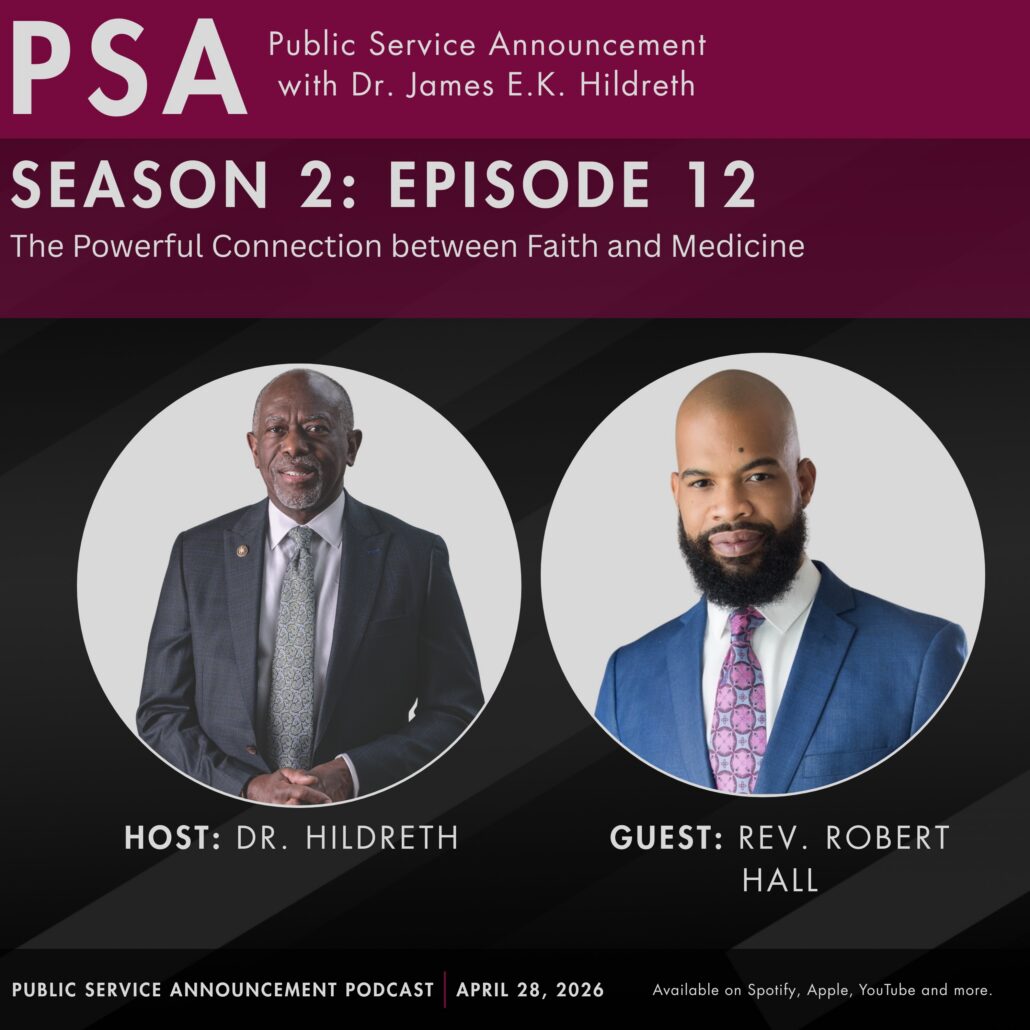
Rev. Robert Hall is redefining healthcare at Meharry by integrating faith, community, and medicine to train providers who treat the whole person — not just the condition.
What if the key to better healthcare isn’t just found in labs and clinics, but in community, faith, and trust?
At Meharry Medical College, Reverend Robert Hall is helping bridge the gap between spiritual care and medical practice, showing that healing extends far beyond physical treatment.
In this episode of Public Service Announcement, the chaplain at Meharry Medical College and special advisor to the president shares how faith and science are not opposing forces, but complementary lenses, working together to prepare healthcare professionals who can care for the whole person, not just the condition.
A Calling That Began in the Community
Hall’s journey to Meharry is rooted in the very neighborhood that raised him.
“I’m the son of North Nashville, Tennessee,” he shares. “What drew me to Meharry is the fact that there was an opportunity for me to continue to advance my work in ministry in the neighborhood that raised me.”
For Hall, Meharry represents more than an institution; it is an extension of his life’s work in ministry and community impact.
Reflecting on Meharry’s 150 year legacy, Hall doesn’t shy away from the challenges it faced: pandemics, world wars, systemic racism, and economic hurdles.
Yet, he notes that the school has done more than survive those obstacles.
“Survival is just being able to make it through, but preservation is to know that even as I’m going through various storms, I’m able to continue to thrive and grow,” Hall articulates.
“Meharry stands out,” he believes, because “it is still a strong beacon of light, not just in America, but over the entire world.”
Why Meharry’s Mission Endures
Unlike many institutions, Meharry’s sustainability is not tied solely to funding.
“Our mission is not contingent upon our funding cycle. It’s contingent upon our purpose.”
That purpose — serving the underserved — ensures that Meharry’s work remains essential.
“There’s always going to be an opportunity for us to serve the underserved,” Hall says.
Meharry’s unwavering focus of fulfilling that mission has allowed the institution to thrive where others have struggled.
“It’s important for us to understand that what continues to motivate and allow us to keep the doors open is to know that we have a specific target that most people overlook,” he says.
“There’s always going to be work for us to do just as Jesus said, the poor will be with you always.”
Career vs. Calling: A Defining Lesson for Students
One of Hall’s most powerful teachings centers on the difference between a career and a calling.
“Your career is what pays you and your calling is what pulls you,” he shares, noting that at Meharry, students have a rare opportunity to align both.
“They’re able to have their pulling, that gravitational pull towards the special thing that God has put inside of them,” he says. “And they’re able to do that every day and also get paid for it.”
This alignment transforms education into purpose, preparing students not just for jobs, but for lives of service.
Faith and Science: Not Opposites, but Partners
As a devoted minister, Hall challenges the common misconception that faith and science exist in conflict.
He sees them rather as partners.
“When it comes to science, it appreciates faith in a very unique way,” he says. “When we think about all of creation that God uniquely set into order, science basically asks the question ‘how?’”
Together, he argues, the two create a fuller understanding of both the human body and the human experience, one grounded in both evidence and belief.
“Science wants to know, ‘how does it work?’ Faith says, ‘it can.’”
When it comes to healing the sick, for Hall, it is more than just physical treatment. Again, he welcomes the “collision” of medicine with faith.
“Faith comes in to help people understand the process is not just in the treatment of medicine, but also their view on their healing, their positive mindset that they’re going to get through this and they’re going to get over it,” he says.
“It is important for the faith community and also people of faith to understand how their belief impacts their reality and also the outcome of their treatment even more than the medicine.”
Hall’s unique perspective highlights the importance of treating the whole person, not just the illness.
Bridging Trust Between Medicine and the Community
Trust remains a critical issue in healthcare, especially within historically marginalized communities.
Hall explains why faith leaders often hold a unique position of trust.
“As faith leaders, we often are there before the crises — before the bad news hits, before the recovery, before the sickness or the illness is apparent.”
From births to weddings to weekly worship in the community, relationships are built long before medical intervention is needed.
By contrast, medical relationships often begin during moments of urgency. To bridge this gap, Hall advocates for deeper collaboration.
“How we bring those two together is to understand as a faith community, treat not just the spirit of the parishioner, but the whole person. Be concerned that it’s just not their soul that is being challenged, but also their health as well,” he shares.
Hall suggests bringing the doctor into the church or looking at the church as another holistic hub where medicine and faith can take place at the same time.
The COVID-19 pandemic reinforced the importance of faith-based partnerships in public health. Churches became vital centers for education, outreach, and prevention.
“COVID taught us that the church has to be more of a community agent when it comes to the health of our members,” Hall says, emphasizing that health awareness should be part of regular community life — just like spiritual guidance.
“We see it from a communal standpoint, not just keeping myself from being sick, but if the whole community has that type of mindset, I believe that we do a better job.”
A Legacy of Gratitude and Service
One of the most powerful lessons Hall highlights is rooted in Meharry’s origin story.
“The greatest oversight of any human is to be blessed by God and not say thank you,” he shares. “Never forget to say thank you.”
Beyond things forgotten, he suggests there are things we should always remember.
“The precipice of our institution comes from one thank you, and that thank you has now become 150 years of thank yous, that we can now not even count. And so we should always remember that those thank yous begin to birth more opportunities for gratitude and opportunities for service.”
That spirit of gratitude has fueled generations of service.
“Because one person said thank you, millions and countless individuals are able to do the same thing.”
Hall closes with a simple but powerful challenge — see a need, fill that need.
“I think being knowledgeable of the needs of our respective communities is a charge that we all should know,” he says. “Once you know what that need is, I think our job then is to engage in our agency. How can we fill that need?”
Rather than observing problems from a distance, he encourages action.
“Understand that no matter what your calling is and our different gifts, we all share the same calling, and that is to fill the needs as we see those making themselves apparent in our lives and in our community.”
“Find a way to solve the issue,” Hall says.
For Meharrians, that service is not optional. It is the mission.
Be sure to follow Public Service Announcement with Dr. James E.K. Hildreth on Apple, Spotify, YouTube, or wherever you get your favorite podcasts. For more content like this, join the conversation online at mmc.edu/podcast.