
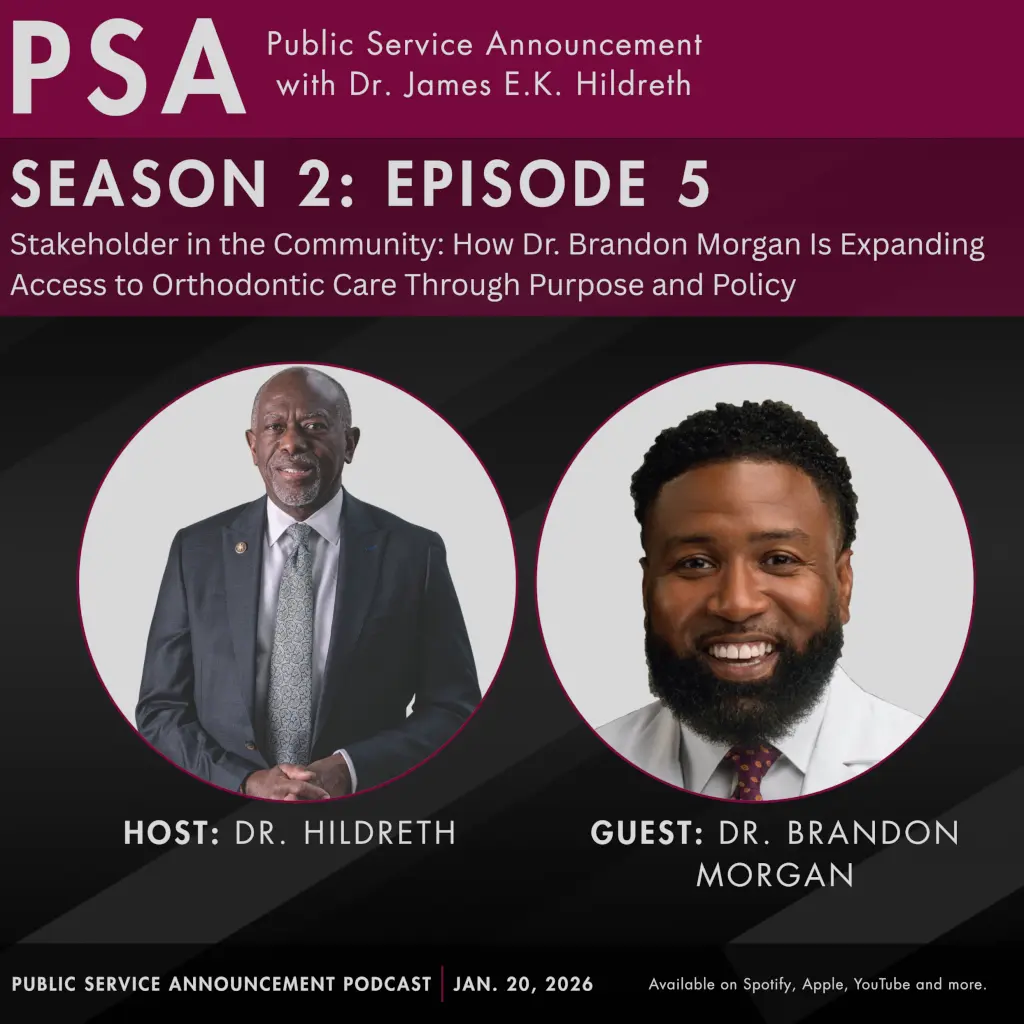
Dr. Brandon Morgan, 2013 Meharry alumnus, and the founder of Iconic Orthodontics in Atlanta, Georgia, exemplifies what it means to serve patients not only as a provider, but as a trusted part of the community.
For Dr. Brandon Morgan, orthodontics is about far more than straightening teeth. It’s about showing up for the community he serves.
As the founder of Iconic Orthodontics in Atlanta and a graduate of Meharry School of Dentistry, Morgan has built a practice rooted in access, equity and purpose. By combining clinical expertise with health policy insight, Medicaid advocacy, and deep community engagement, he is redefining what it means to be both a healthcare provider and a stakeholder in public health.
A Mentor in the Next Room
Morgan’s journey into dentistry began at home.
“I am a native of Atlanta, Georgia, where I was raised by my mother and father who are in the sciences and also in education,” he shares. From an early age, education, service and exposure to science and the arts were part of daily life and experiences he says shaped both his worldview and his career path.
Beyond his parents, family mentors also played a critical role. “I had a couple dentists in my family, an uncle and a cousin,” he explains, describing time spent shadowing in his uncle’s Chicago practice and learning from a cousin who recalls was “the only minority in her dental school class.”
While these experiences grounded his belief that dentistry, he found orthodontics in particular was the right fit, blending science, health care, aesthetics and art.
While earning his DDS at Meharry, Morgan also pursued a certificate in health policy — an uncommon but intentional choice.
“From a very young age, [my parents] always encouraged us to participate in community service and different community initiatives,” he says. “I was one of those kids that anytime the teacher would present an opportunity over the weekend, if there was a health walk or anything like that, I always wanted to volunteer.”
That early foundation, combined with his undergraduate experience at Emory University and involvement in community-focused organizations, deepened his understanding of how systems, policy and access shape health outcomes.
When he reached Meharry, the mission spoke to him.
“Meharry is a school that emphasizes giving back to the underserved and serving the underserved communities,” he adds, noting that these experiences helped him understand not just how to serve, but why it matters.
Morgan finished his residency here, then attended Howard University for orthodontics, where the opportunity presented itself to return home to Atlanta to create a Medicaid orthodontic program for a pediatric office, Beautiful Smiles — owned by yet another Meharrian.
“The idea was initially presented to him due to the lack of access that patients had for orthodontic treatment. And so he needed someone to come in and get that program up and running.”
Morgan understood it was going to be a challenge, as orthodontists are often considered to be “a luxury” within the dental community.
“A lot of people do not have the means to go about receiving this type of treatment.” But the biggest challenge was resources. “Financial resources are limited, providers are limited, and facilities that are willing to provide this type of care to the underserved communities are also limited as well.”
Over time, however, the program served more than 2,000 patients and demonstrated what’s possible when access is prioritized.
Designing a Non-Traditional Dental Experience
Morgan’s experiences at Beautiful Smiles deeply influenced how he built his own hometown practice, Iconic Orthodontics.
“We made sure that there are no traditional walls between the lobby and the clinical area — only glass,” he explains.
“I wanted to make sure our patients understood that while this is a professional environment, we want it to be welcoming — so that they will understand better what we’re trying to do and not feel that divide between them as patients and us as providers.”
The result is an environment that feels open, welcoming and collaborative rather than intimidating. Patients have noticed. “They love it,” he says.
Beyond the design of the office, Morgan also challenges traditional models of dental practice, approaching it from a more “holistic approach.”
“When I treat my patients in my own private practice now, I always look at what’s going on in the patient’s home, at other concerns that may be present,” he says, stressing the importance of understanding what’s happening beyond the dental chair, at home, in school, and in the community. “They may influence the way treatment goes.”
As Morgan explains, orthodontic treatment is not a single visit — it’s a long-term commitment, highlighting why continuity of care is critical.
“A typical case for a lot of patients may be two years,” he says,noting that more complex cases take even longer. Yet Medicaid requirements often demand high complexity while limiting treatment timelines, creating systemic barriers for underserved patients.
Social challenges compound the issue. “A lot of these patients are transient or they have other social issues that keep them from being able to commit to this type of treatment,” he says, underscoring the need for a more holistic approach to care.
“Knowing all of that ultimately creates a better experience for my patients and also creates better outcomes when it comes to their treatment.”
Being a Stakeholder Beyond the Dental Chair
Morgan’s holistic philosophy is deeply embedded in both the delivery of care and in community engagement.
“When I created my office, there was a sense of responsibility and a sense of fulfillment that I had,” he says. “I knew that it was important for me to make sure that not only am I providing orthodontic care for my patients, but also that I am a stakeholder in the community that I serve.”
From annual back-to-school events to consistent local engagement, his practice maintains a visible presence outside the clinic walls. “We always try to make sure that we have a presence in our community, to make sure that we’re engaged.”
The results are beneficial for his patients, but also his peers. “My staff really appreciates the opportunities we get to interact with our patients outside of our office and also see the impact that we’re able to have that doesn’t relate to dentistry.”
Mentorship as Responsibility, Not Optional
“Considering the background of my parents,” he says, “the importance of giving back to the community and furthering education was very important to me.”
These early lessons taught Morgan to see mentorship as both a personal and professional duty. “I am the product of those that come before me, and I understand that,” he says.
Over the years, he has hired and mentored pre-dental students, including one young woman who aspired to attend Meharry. “She is a now first year in dental school,” he shares proudly.
“These kinds of experiences definitely showed me that it’s worthwhile,” he adds, reinforcing the importance of reaching back once you’ve made it forward.
When asked about his hoped-for legacy, Morgan is clear: “I want us to have an impact. I want to be recognized as a pillar in the community that I serve outside of dentistry, that I engage with the community and really put a lot of energy and effort into making the community better.”
He also hopes to model creativity, proving that non-traditional approaches can produce better patient experiences and outcomes.
“Always be genuine in your intentions and be true to yourself.” He emphasizes the importance of reflection, intentionality, and understanding that “there’s more than one way to get to where you want to be.”
Whether through policy, volunteering, private practice or nonprofit work, Morgan urges professionals to be “creative and intentional” in combating healthcare disparities.
“There are many ways to serve the underserved community, volunteering, working in politics or policy,” he says. “Even if you have a private practice, take a step back and create ways in which you can help with decreasing disparities within the health care community.” For his part, Morgan is creating a non-profit to serve those often marginalized and overlooked.
He closes with a call to action rooted in Meharry’s mission.
“Pay attention to the mission of Meharry,” he shares. “If you really spend some time with it, you will understand that it really does take the work of each one of us individually to improve health care and do what it needs to do to progress it.”
Be sure to follow Public Service Announcement with Dr. James E.K. Hildreth on Apple, Spotify, YouTube, or wherever you get your favorite podcasts. For more content like this, join the conversation online at mmc.edu/podcast.