
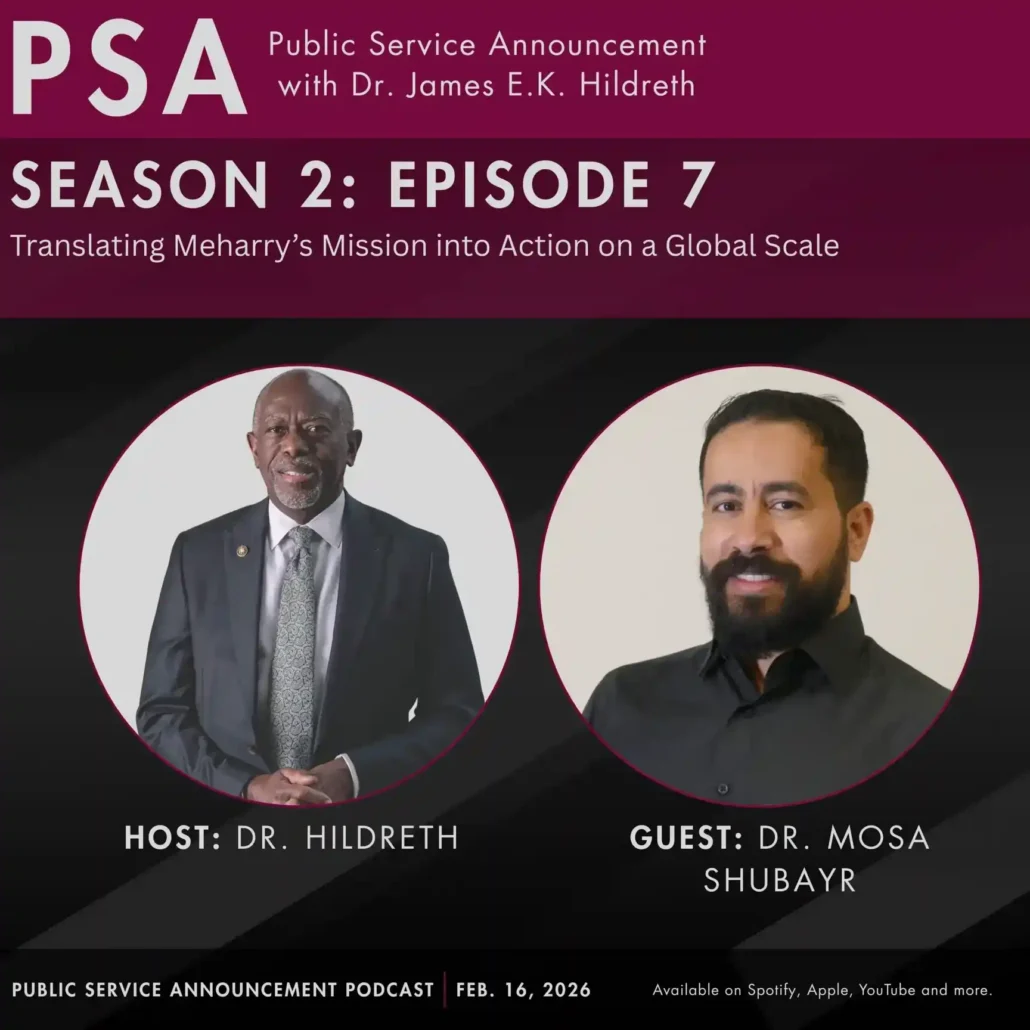
The work of Dr. Mosa Shubayr, executive director of Jazan University Dental Hospital in Saudi Arabia, demonstrates a powerful blend of academic rigor, cultural awareness and community-centered leadership.
For Dr. Mosa Shubayr, public health is not confined to a clinic — it is a commitment to communities. A 2018 graduate of Meharry School of Graduate Studies, Shubayr has carried the institution’s mission across continents, blending compassion, data and cultural understanding to transform oral health services in Saudi Arabia.
Now serving as executive director of Jazan University Dental Hospital and Vice Dean of Clinical Affairs, he is leading large-scale community initiatives that have reached tens of thousands of people.
His journey reflects the global impact of Meharry’s legacy and the power of integrating research, education and service to advance health access worldwide.
Finding His Path: “I felt that I had found my path at Meharry.”
Shubayr’s passion for public health began early.
“It was my passion since I was young,” he recalls. As a child, he accompanied a physician serving local communities and witnessed firsthand the burden of untreated dental disease.
“So many people suffering from dental pain, children, and a lot of people. That’s why I wanted to help.”
When he arrived at Meharry, that passion crystallized into purpose. “When I learned about the public health in dentistry, I felt that I had found my path at Meharry.”
He was drawn deeply to the institution’s service-oriented mission.
“Reading the Meharry mission statement,” he says, “is all about the underserved and thinking that’s exactly what I need to be. And I was right.”
For Shubayr, Meharry offered more than academic training.
“Meharry taught me more than academics,” he shares. “It taught me compassion, leadership and what it truly meant to me to serve the community as well.”
Blending Compassion and Systematic Thinking
After earning his MSPH at Meharry and completing a PhD in dental public health at the University of Western Australia, Shubayr returned to Saudi Arabia to assume leadership roles at Jazan University.
From Meharry, he gained grounding in health behavior and health promotion. From Australia, he learned the “power of data” and health care systems design. Together, they formed the backbone of his leadership approach.
“When I returned home, I realized that I had to merge these strategies, compassion from Meharry and systematic thinking from Australia,” he says. “This combination helped me approach health care and help in the community in Saudi Arabia and in Jazan especially.”
Another lesson carried over from his studies emphasizes that effective public health must align with the culture of the community being served.
“Culture shapes people, how they think, how they live,” he explains. “When we understand the culture, we understand their behavior and how to behave.”
Drawing on his master’s thesis work in health behavior, he now designs programs that account for local beliefs, practices and social norms — ensuring that interventions resonate with communities rather than impose external models.
Reaching 70,000 People
One of Shubayr’s most impactful initiatives is a kafalah dental program, a large-scale community outreach effort in rural Jazan.
“It is the biggest one,” he says. “And we have reached about 70,000 people.”
The program integrates education, diagnosis, referral and treatment. Over 2,000 individuals have been referred for free clinical treatment, while thousands more have received lectures, screenings and online consultations.
It’s another lesson he took from his time at Meharry.
“That program was based on different strategies, but one of the strategies I have learned from Meharry.”
The key, he explains, is scale, structure and strategic integration.
Integration as Strategy
When asked what has been most effective in improving oral health outcomes, Shubayr points to one concept:
“Integration” — integration of research, academic training, clinical services and community outreach.
“If we use just the clinical services,” he says, “that will not change — but if we merged all of this, it was the best strategy.”
This model ensures that data informs planning, students reinforce service delivery and clinics provide follow-through care.
Shubayer also believes in using data as the starting point for every initiative — a lesson he picked up from his time in Australia.
“There is power in data.”
Whenever he plans for a new program, Shubayer gathers as much information from both academia and the local community.
“We use all the data from research,” he says. “About their workers and about the population surrounding their organizations.”
By identifying priority needs and focusing on high-impact areas, programs are designed intentionally rather than reactively.
Sustainability Through Community Ownership
Sustaining community health programs remains a challenge globally — but Shubayr believes the solution is clear: ownership.
“This is really a big challenge for us to make it sustainable in the region, but we try to make it sustainable through the community itself,” he says.
Rather than creating dependency, his team trains teachers, families and community leaders to continue educational efforts independently.
“We’re trying to teach the teachers and the people who benefit from our program,” he explains. “We’re trying to give them the material and teach them how to teach others, their families and in the schools.”
Digital tools, including online consultations and virtual lectures, reinforce continuity.
“That will help us make it a little bit sustainable.”
A Message to Meharry: “Lift others.”
When invited to share a call to action, Shubayr’s gratitude is clear.
“Meharry taught me to lift others,” he shares. “And once they learn that, they will carry it with them wherever they go.”
He credits Meharry’s faculty for equipping him to serve communities across continents.
“Thank you for helping me to help people.”
From Nashville to Australia to Saudi Arabia, that mission has traveled with him, forever on the path.
Be sure to follow Public Service Announcement with Dr. James E.K. Hildreth on Apple, Spotify, YouTube, or wherever you get your favorite podcasts. For more content like this, join the conversation online at mmc.edu/podcast.