
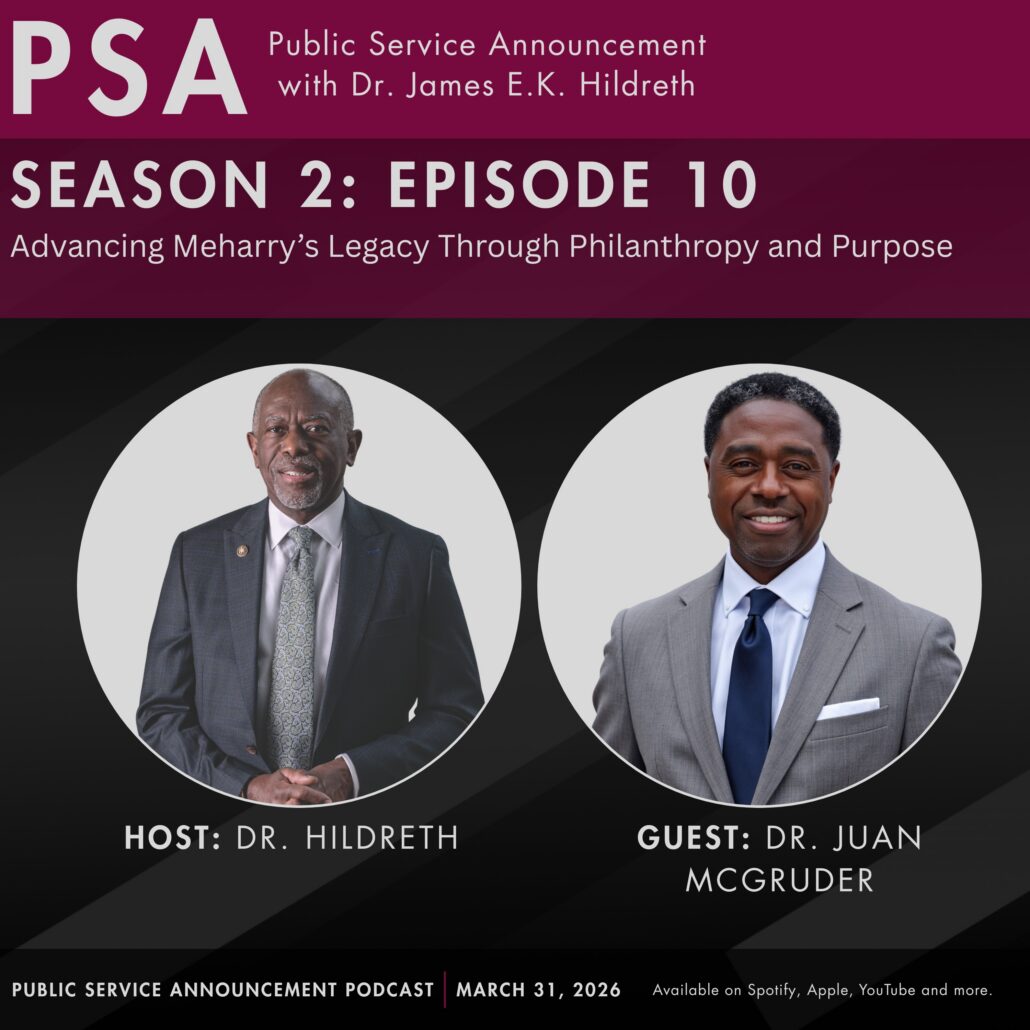
Sr. VP of Institutional Advancement, Dr. Juan McGruder, explains how philanthropy and strategic fundraising power Meharry’s mission, highlighting the unique challenges of HBCUs and why expanding resources drives health equity.
Behind every scholarship awarded, every research breakthrough, and every future healthcare leader trained at Meharry Medical College is a strategy — and a story — of investment, partnership, and purpose.
With more than 25 years of experience in higher education, McGruder leads the college’s fundraising, strategic partnerships, and development efforts, helping to secure the resources that sustain Meharry’s mission and expand its impact.
At a time when health care equity, education, and institutional sustainability are more critical than ever, McGruder offers a behind-the-scenes look at what institutional advancement really means — and why it plays a central role in shaping the future of historically Black medical schools.
A Journey Rooted in Service and Calling
McGruder shares his own path to Meharry was a personal and spiritual journey.
“I see this as a divine assignment for me,” he says. “This is something that God has ordained for me to be here and to serve Meharry at this time.”
Growing up in Houston’s Third Ward, he faced early academic challenges. After being denied admission to his only college application — Clark College in Atlanta, Georgia — his mother encouraged him to try again in a different way.
“‘Write them a letter,’” she told him. “‘Just tell them how you feel.’”
His response became a defining moment for him: “If you accept me, I promise to be a good student and an even better alumnus.”
That appeal led to acceptance — and ultimately, a lifelong commitment to service.
“It was embedded in me early on how important it was to serve no matter what you’re doing in your community or your profession,” he explains.
His higher education continued with time at Harvard, University of Cambridge and Vanderbilt University, where he earned his Ph.D.
With a solid foundation of education, faith and leadership combined with his call to serve, Meharry, he felt, was the next perfect fit.
“I saw it as a wonderful opportunity for me to serve at a critical time in the history of the institution that I respected greatly.”
What Institutional Advancement Really Means
Institutional advancement is often misunderstood as simply fundraising, but McGruder frames it as something much broader.
“I see divisions of institutional advancement,” he explains, “as primarily a revenue center.”
At historically Black colleges and universities, this role is especially critical. Many institutions have historically relied heavily on tuition revenue, creating a fragile financial model.
“I’ve always seen it as a flawed revenue model because it’s not sustainable,” he says. “If you don’t have endowments, you don’t have program support, you don’t have greater operating funds and that kind of stuff, it’s very hard to meet your mission in ways that are robust and strong.”
To ensure long-term sustainability, that model must evolve.
“You have to diversify your revenue pie,” he says. This diversification includes building partnerships, expanding philanthropic support, and strengthening institutional reputation.
“Institution advancement should also be engaged in enhancing and protecting the reputation of the institution.”
The Unique Challenges Facing HBCU Medical Schools
While fundraising principles are universal, the historical context of HBCUs presents unique challenges.
“We’ve been historically underfunded,” McGruder shares, addressing the long-term impact of the Flexner Report, which contributed to the closure of multiple Black medical schools and damaged their reputations.
“We lost a lot of medical schools during that time.”
For decades, Meharry and Howard stood as the only Black medical schools in the country, carrying the responsibility of educating generations of Black physicians with limited resources.
“And so we were sort of an underdog,” he explains. “We became stagnant in terms of our resources and had to be very independent in terms of our resource development.”
Despite these challenges, for McGruder, the essential mission remained clear.
“We produce what the nation needs, which is more Black physicians.”
Building Sustainability Through Endowment and Storytelling
To create long-term stability, McGruder emphasizes the importance of endowment.
“Endowment is critical,” he says, “because it’s about sustainability and not just current operations.”
But McGruder believes funding alone isn’t enough; institutions must also clearly communicate their impact.
“We have to elevate our profile by telling our story.”
Meharry’s story is one of relevance, impact, and necessity, particularly in today’s healthcare landscape.
“Our contribution to the nation, to the city of Nashville and the state of Tennessee — and really across the world — is a strong story in terms of what we produced and the role that our institution has played in the nation and the Black community in particular.”
When that story is effectively communicated, it becomes a powerful case for support.
“We try to utilize that as much as possible to garner support from our various constituencies,” he says. “When you showcase your relevance, it’s hard to say no.”
150 Years of Meharry: Strengthening Legacy and Relationships
As Meharry celebrates its 150th anniversary, institutional advancement plays a key role in deepening relationships with alumni and partners.
“This is a special time in the history of this storied institution,” he says. “And so we have put together over 20-plus events over a yearlong celebration period.”
Anchored by the theme “Forever on the Path,” the celebration highlights Meharry’s enduring mission and impact.
“We have a number of stories that really define who Meharry has been and the impact that we’ve made to the nation and obviously in this community,” he shares. “All of this in an effort to not only showcase who we are but to really galvanize and deepen our relationship with our alumni, our corporate partners, our friends.”
Once again, the relevance of the mission is critical to the message.
“Invest in us, in who we are, because you know Meharry is what the nation needs today, yesterday, and of course tomorrow.”
Be sure to follow Public Service Announcement with Dr. James E.K. Hildreth on Apple, Spotify, YouTube, or wherever you get your favorite podcasts. For more content like this, join the conversation online at mmc.edu/podcast.